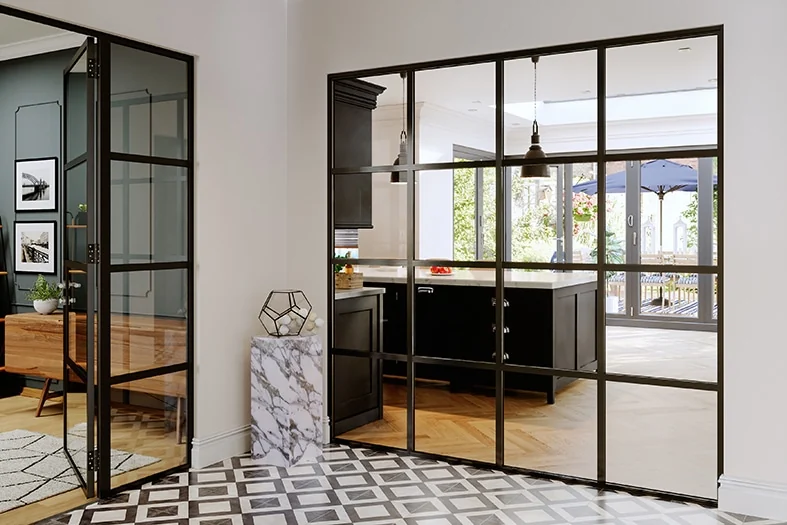
The useful answer
Visual privacy and acoustic separation are different specifications. Obscure glass can soften a view without stopping speech; a sealed door may help separation but still needs evidence for any claimed acoustic rating.
Ask what is tested, and what is being supplied
Sound can pass through glass, gaps around a leaf and adjoining construction. Ask whether a quoted figure applies to the glass alone or to the complete doorset or screen. Confirm whether the tested arrangement includes the same seals, threshold, glass and operating type as your proposal. A sliding opening and a hinged opening should not be assumed equivalent because the frames look similar.
For privacy, consider silhouettes and lighting. Textured, reeded or frosted glass changes detail, but the result depends on distance and whether the person is close to a brightly lit pane. View a relevant sample in comparable conditions. If the need changes during the day, an adjustable blind may suit better than permanently obscured glass, provided its fixing and clearances are coordinated.
A situation you can apply to your own project
A study user wants calls to be private while still borrowing light from the kitchen. Write two acceptance questions: can people see sensitive screen content through the glass, and what acoustic evidence supports the proposed complete partition? Testing a sample for appearance answers the first, but does not prove the second.
Compare the practical details
| Decision | What it means for your project |
|---|---|
| Visual screening | Compare samples at realistic distances and with lights on. |
| Speech privacy | Request complete-system evidence and check surrounding walls and openings. |
| Sliding operation | Ask about perimeter gaps, overlap and sealing arrangements. |
| Fire separation | Specify a suitable tested assembly if required; style is not evidence. |
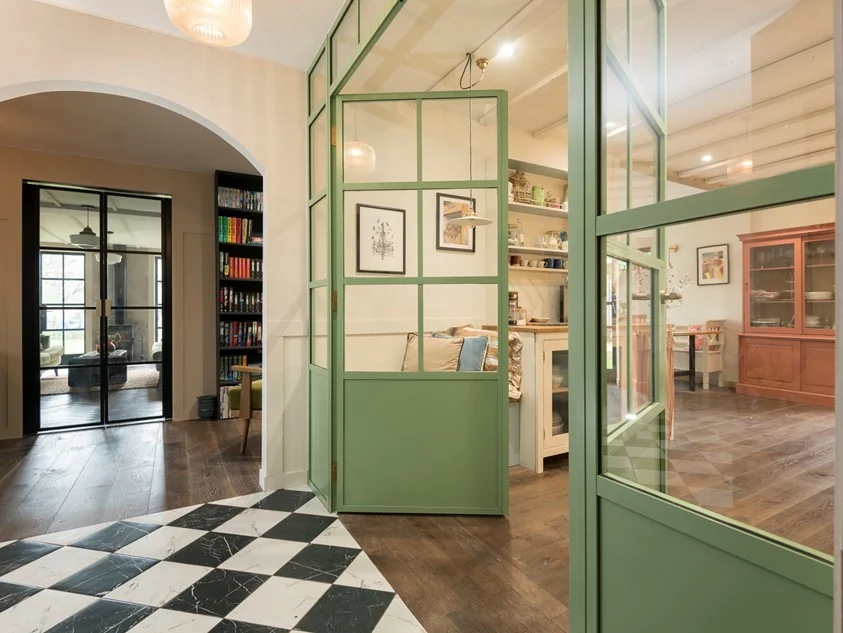
Work through the specification
Name the outcome
Do you want visual privacy for a study, a boundary around a kitchen, less distraction from television or a place for confidential calls? These are different requirements. Describe the room use instead of requesting a vague soundproof door.
Consider the whole partition
The glass, door perimeter, gaps, adjoining walls and ventilation paths all belong in the conversation. Ask for evidence relevant to the complete proposed arrangement if acoustic performance matters.
Choose privacy in realistic lighting
Compare clear, patterned and obscured glass samples in the conditions you expect. Think about silhouettes and views from both sides. A decorative bar pattern changes appearance but should not be treated as a privacy specification.
Reconcile the layout with operation
Sliding, hinged and fixed sections create different routes and interfaces. Ask the supplier to show how the chosen arrangement closes and how it affects the separation you need. If any fire performance is required, obtain a specifically suitable evidenced solution.
Your checklist before the next conversation
- Define visual and acoustic needs separately
- Record the exact glass
- Ask what the acoustic evidence covers
- Check seals and bottom gap details
- Avoid treating soundproof as an unqualified promise
Questions people ask
Are steel-look doors soundproof?
Appearance does not establish acoustic performance. Ask about the exact complete system and surrounding construction.
Will a glazed partition stop kitchen smells?
Discuss gaps, door operation and the ventilation design. Do not assume the partition alone will achieve that outcome.