The useful answer
A blind must clear the door in every operating position, not just when shut. Check the headrail, gathered blind, handle projection and moving panels together before either product is ordered.
Create one clearance drawing for both suppliers
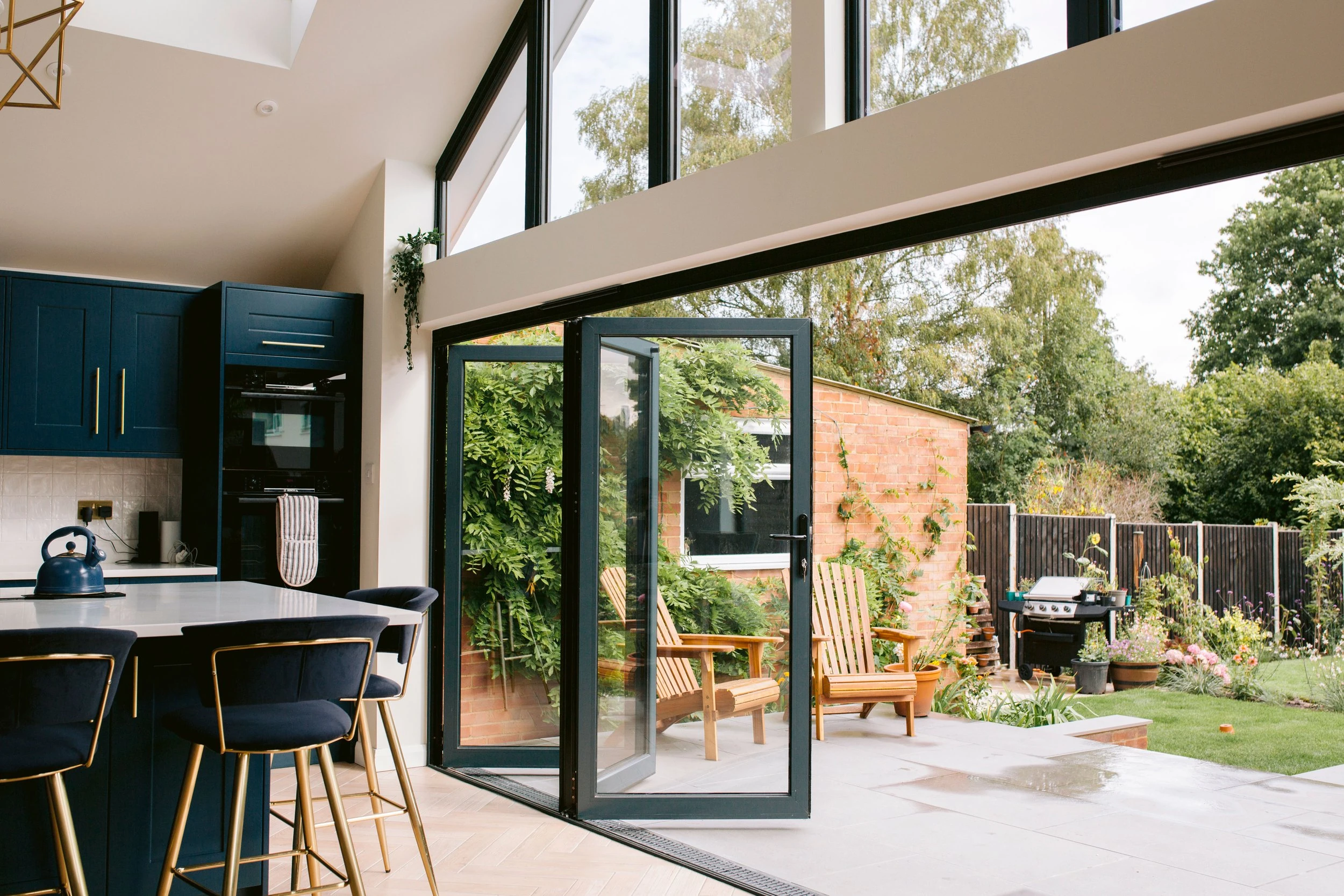
Draw a section through the top of the opening and another through the handle. Include the blind’s position when raised, lowered and gathered. With bifolds, show the entire stack; with sliders, show the gap between adjacent moving leaves. With inward-opening doors, show the blind or curtain behind the swing arc. Obtain the relevant dimensions from the actual proposed products.
Integral blinds remove some room-side hardware but introduce their own operating and service arrangements inside the glazing unit. Ask how they are controlled, what the warranty covers and what must be replaced if a mechanism fails. Surface-mounted systems can be easier to change, but their fixings and adhesives still need approval for the chosen frame and finish.
A situation you can apply to your own project
A roller blind fits neatly in a reveal while the door is closed, but its lower rail meets the handle when lowered. Moving it forward may solve that clash while creating another with a folding stack. Send the same annotated drawing to the blind supplier and glazing supplier, rather than relying on separate assurances that each product is suitable.
Compare the practical details
| Decision | What it means for your project |
|---|---|
| Recess-mounted blind | Check headrail depth and handle projection. |
| Frame-mounted blind | Confirm fixing approval and clearance throughout movement. |
| Integral blind | Compare operation, glass specification and repair arrangements. |
| Curtains | Reserve gathered fabric space away from stacks and daily access. |

Work through the specification
Draw the blind in its working position
A blind occupies space when lowered and when gathered. Show the headrail, recess, handle and opening leaf to both suppliers. For bifolds, include the folded stack; for sliders, check the relationship between adjacent moving panels.
Compare the maintenance arrangements
Ask how an integral blind is operated, what happens if the mechanism fails and which warranty covers it. For separately fitted blinds, check removal, cleaning, attachments and whether the frame supplier approves the proposed fixing.
Test the view from outside at night
Describe the privacy needed when the room is lit. A glass coating, light-filtering fabric and an opaque blind provide different experiences. Ask for samples and discuss the actual lighting conditions rather than relying on a showroom impression.
Make one person reconcile the details
Before ordering, keep the selected door drawing and blind proposal together. Ask for written confirmation of compatible clearances and hardware. Avoid leaving the blind choice until after the plaster reveal has set the available space.
Your checklist before the next conversation
- Use actual product dimensions
- Show raised and lowered positions
- Check every moving leaf
- Agree approved fixings
- Keep blind and glazing warranties separately identified
Questions people ask
Can I fit a blind to any frame?
Fixing methods and clearances differ. Obtain approval for the exact frame and blind combination.
Do blinds solve summer overheating?
Discuss glare, solar gain and ventilation separately with your designer. A privacy solution is not automatically a whole-room comfort solution.